
KALI ZHANTILEUOV’S DOMBYRA
Описание
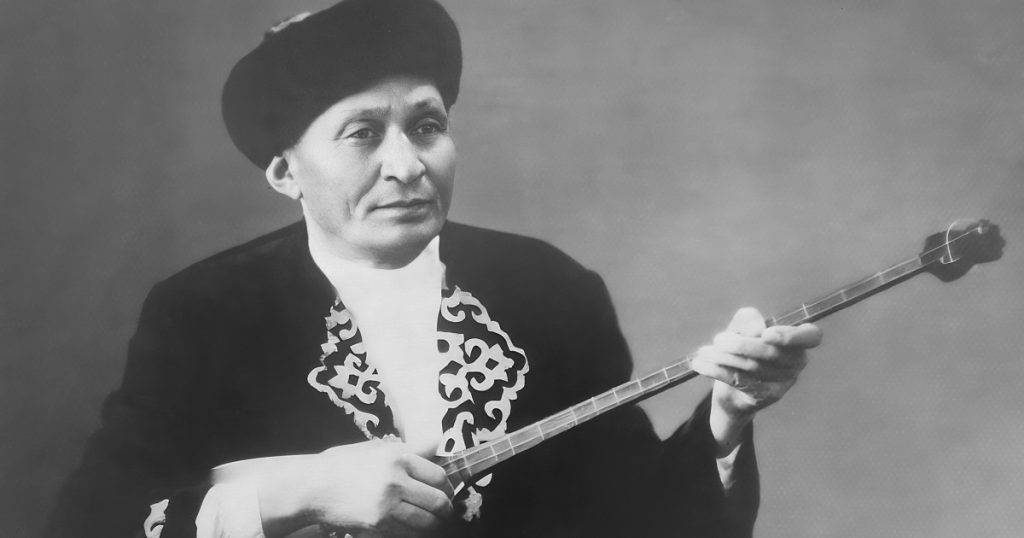
рeople’s Artist of Kazakhstan, singer and dombyra player (kuishi)
Master craftsman: Kamar Kassymov
 Kali Zhantileuov’s dombra is one of the most distinctive instruments in the museum collection because it is an original instrument. In 1977, Sara Tanabayeva, who was the director of the West Kazakhstan Regional Museum of History and Local Lore at the time, traveled to Almaty and brought the dombra from Kali Zhantileuov’s home. The instrument was made by Kamar Kassymov, a master craftsman renowned for his expertise in traditional Kazakh musical instruments. Even after the age of seventy, the küyshi Kali Zhantileuov performed Kurmangazy’s Aman Bol, Sheshem, Aman Bol! and Mamen’s Karazhan Khanym on this very dombra.
Kazakh kuy art is a unique cultural phenomenon that has preserved and transmitted the nation’s spiritual memory and historical experience across centuries. One of the outstanding figures who made an invaluable contribution to the development and preservation of this art in the twentieth century was Kali Zhantileuov. He was not merely a performer; he was also a custodian and chronicler of the kuy tradition, ensuring the continuity of its authentic heritage for future generations. In this sense, he served as a bridge connecting two generations.
Kali Zhantileuov’s artistic legacy holds particular significance as a prominent continuation of the Kurmangazy school within the Kazakh küy tradition.
Kali Zhantileuov (1902–1993) was born in what is now the territory of West Kazakhstan Region. He spent his childhood in a traditional Kazakh environment surrounded by kuy and oral poetic traditions. Since the sound of the dombra was an integral part of everyday rural life at the time, Kali’s musical talent became apparent at an early age.
His first teachers were members of his extended family and relatives. They introduced the young Kali to the musical heritage of such great küyshis as Kurmangazy, Dauletkerey, Turkesh, and Baizhuma. During his childhood, Kali Zhantileuov, together with his friend Okap Kabigоzhin, witnessed the kuy tartys—a traditional musical performance and contest—between Dina and Mamen. This experience inspired him to devote himself entirely to the art of küy. It is said that he spent considerable time with Mamen and learned a number of his compositions directly from him.
By the 1930s, Kali Zhantileuov had become well known among the people. In 1934, at the First Competition of Performing Arts Masters in Kazakhstan, he gave a masterful performance of the Adai kuy, impressing both the audience and the jury. This marked the beginning of his professional career as a dombra performer, and he went on to become one of the leading masters of Kazakh kuy art.
Kali Zhantileuov’s repertoire encompassed the finest works of the Kazakh kuy tradition. He became particularly renowned as a performer and transmitter of numerous complex and highly accomplished compositions, including Kurmangazy’s Adai and Akbai, as well as Dauletkerey’s Zhiger and Topan.


1. Dauletkerei Shygaiuly’s Kui “Salyk Olgen” — Kali Zhantileuov (1970)
2. Balamaisan’s Kui “Duniegapyl” — Kali Zhantileuov (1971)
3. Kui “Sokyr Eszhan” — Kali Zhantileuov (1971)
4. Dauletkerei’s Kui “Topan” — Kali Zhantileuov (1971)
5. Kurmangazy’s Kui “Kisen Ashkan” — Kali Zhantileuov (1971)
6. Kurmangazy’s Kui “Kishkentai” — Kali Zhantileuov (1971)
7. Mamen Muratuly’s Kui “Aksholpan” — Kali Zhantileuov (1971)
8. Dauletkerei’s Kui “Kudasha” — Kali Zhantileuov (1972)
9. Traditional Kui “Kart Nauaiy” — Kali Zhantileuov (1979)